Key Issues in Playground Upgrading
Many communities in BC and across Canada have older play structures that can and should be upgraded in a programmed fashion to meet today’s CSA playground standards.
A frequent rationale I hear for not upgrading usually incorporate some version of “we have not had any accidents reported on this equipment, so why should we replace it before it is worn out? My response is this: One, statistics show a significant number of recorded playground accidents across Canada, from the trivial to the fatal. Two, these statistics can be used to draw significant conclusions about what particular items or conditions on the playground present hazards. Three, even though kids in your community might have avoided serious injury on your playgrounds, very few departments or staff really have any accurate idea of injury data over many years. I think this is just because those injured generally just go home – or perhaps to the hospital and only rarely, such in cases as perceived negligence do those involved contact the parks or schools management. And finally it can be very inexpensive to upgrade a playground prior to an incident rather than pay a claim following an incident.
Here is a thumbnail review of some key issues in upgrading your older playgrounds:
General Maintenance:
The most easily avoided risks are those resulting from wear and tear. A well maintained playground demonstrates at least some regular inspection and care. Contrast this with playgrounds featuring such things as worn S-hooks or rotten and damaged wooden components. Replace worn items, paint appropriately, and be on the lookout for hazards due to worn equipment.
Surfacing: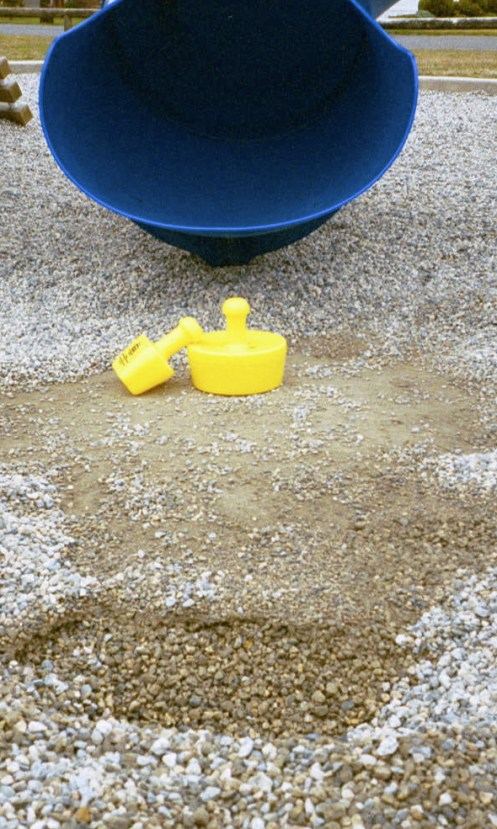

Surfacing materials should be deep! Loose fill surfacing types such as sand or pea gravel require regular maintenance to remain loose and evenly distributed. In my experience, most older playground surfaces would not pass the impact attenuation requirements of, in Canada, the CSA Standard CAN/CSA-Z614-07. Compaction can easily (and repeatedly) reduce the shock absorbing qualities of your playground, so inspect and loosen frequently.
Falls are implicated in about 70 percent of reported playground accidents. If your playground surfacing is not more or less as loose as the day it went in, it should be loosened. Professionals I talk to are either using a rototiller or a small machine such as a Bobcat with a few hardworking rakers to loosen, shovel, and spread the surfacing material evenly.
Higher quality Protective Surfacing such as Engineered Wood Fibre or specialty rubber products although more expensive provide quality shock-absorption and can be lower in maintenance costs over time.
Entrapment Issues:
Entrapment hazard exists when an opening could pass a small body but catch the relatively large head attached to that body. Using plastic probes to detect this hazard I often detect several problematic openings on older wooden climbing structures. Fortunately they are usually not difficult to close up or adjust until they conform. Entrapment can be fatal of course, and there are recorded incidents of this. Why not eliminate this risk for a few hundred dollars?
Entanglement Issues:
Entanglement is a condition in which clothing or parts of clothes such as a draw string, becomes caught on playground equipment. On a playground, a youngster who gets entangled while jumping down a sliding pole or sliding down a slide can be in grave danger if a string or garment around the neck becomes caught and pulls tight against the body’s own weight. In Canada we use a test device to check likely entanglement conditions which is intended to simulate a draw string with toggle. I have found these entanglement issues to be fairly easy to eliminate, for example by filling openings with wood, metal, or caulking.
With a reasonable approach to upgrading, you can proceed along an organized path to compliance with today’s CSA Standard for Playgrounds CAN/CSA-Z614-07 and give the children of your community all the existing excitement, fitness and adventure, but without the most serious and avoidable hazards.
 Playground Info